Key Takeaways
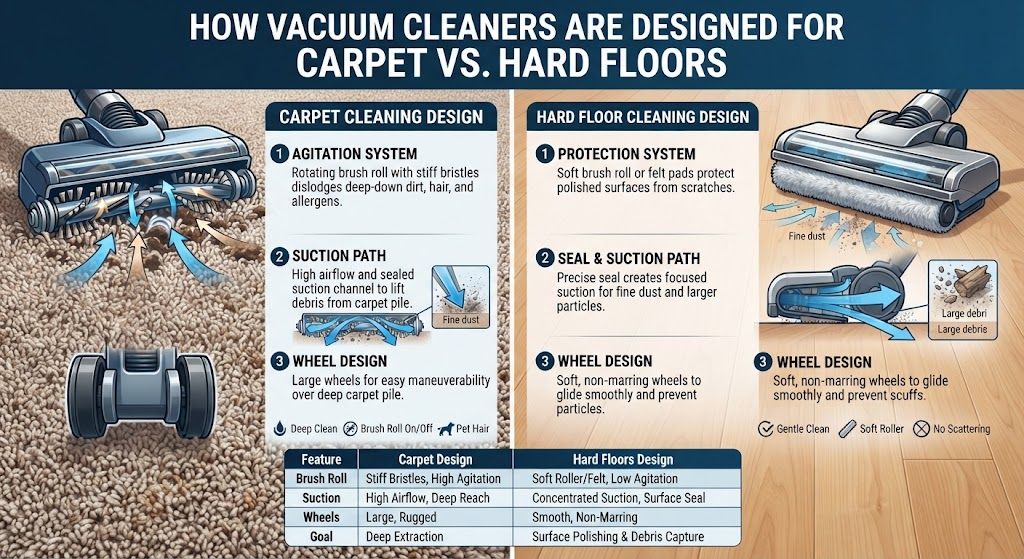
- Carpet cleaning relies on brush agitation, while hard floors need a gentle seal.
- Stiff bristles loosen embedded dirt but can scatter dust on smooth surfaces.
- Soft rollers pick up fine dust on wood and tile without scattering it.
- Suction and brush height both need adjusting between floor types.
- Using the wrong setting can damage carpet fibers or scratch hard floors.
Not every vacuum cleans every floor the same way. Carpet and hard floors trap dirt very differently. Therefore, engineers design brush heads, suction, and settings around this difference. Drawing on technical insights from industry specialists at vacuum cleaners https://bestvacuumcleaner.us, this guide explains how vacuums adapt to each surface. You will learn how to match settings to your own floors.
Why Floor Type Changes Vacuum Design
Dirt behaves differently depending on the surface beneath it. Carpet fibers trap dust, hair, and debris deep within their structure. Hard floors, however, leave debris sitting loosely on top.
According to Eurekaforbes, carpets generally need higher suction power because they trap dust particles and hair deep in their fibers. Hard floors need low to medium suction, since dirt stays on the surface and can scatter easily. This single difference shapes much of a vacuum’s design.
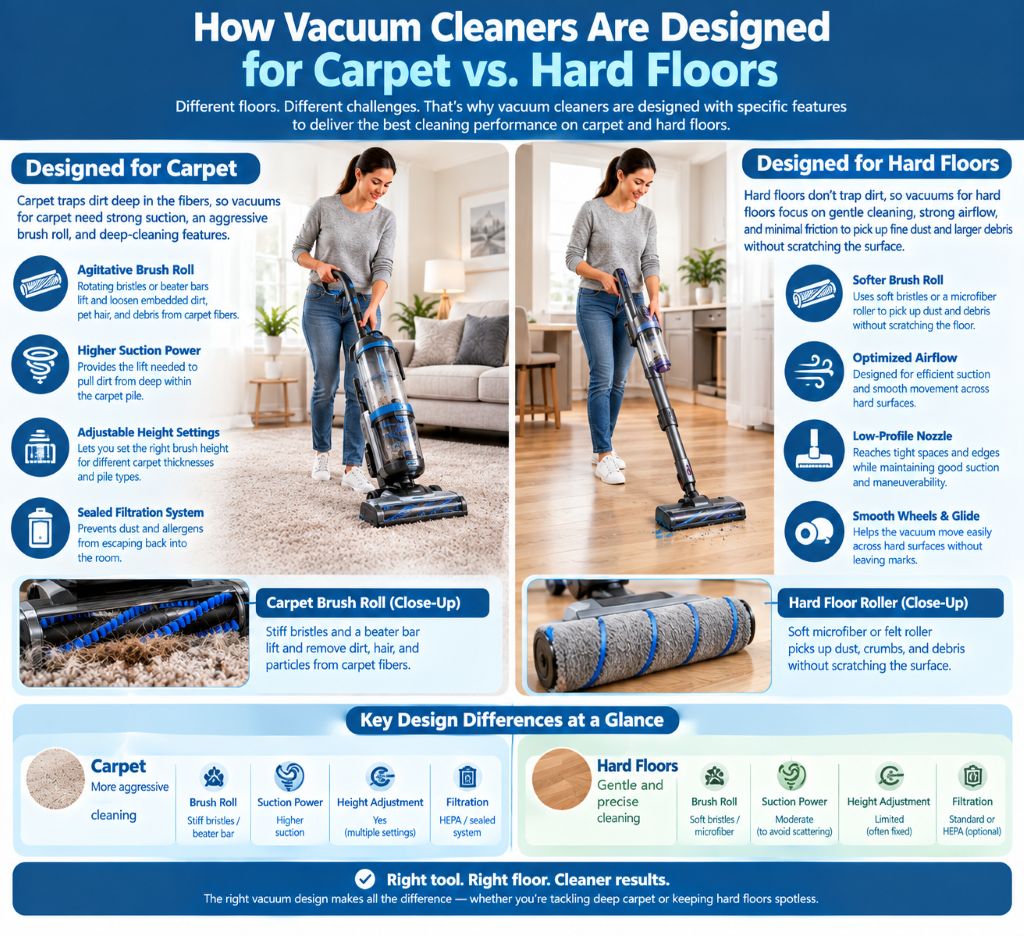
Brush design follows the same logic. Carpet needs mechanical agitation to release trapped particles, which is why specialized tools like the Bissell 3909 carpet cleaner bestvacuumcleaner.us/vacuum-cleaner/bissell-3909-carpet-cleaner/ rely on motorized brush rolls. Suction alone often cannot reach deep into dense fibers. Hard floors need the opposite approach. Stiff bristles can scratch a smooth surface or blow fine dust away from the airflow path.
Height and airflow also differ by surface. Eurekaforbes notes that carpet requires greater head height for proper airflow and movement, while hard floors work better with a lower head height. Therefore, a single fixed setting rarely performs well on both surfaces.
Because of these differences, many manufacturers build adjustable or interchangeable heads. Some vacuums switch brush height automatically. Others require you to swap tools or flip a switch. Either way, the underlying goal stays the same. Match the tool’s action to how dirt sits on that specific floor.
How Brush Rolls Are Built for Carpet
Carpet cleaning depends heavily on a spinning brush roll. This component does mechanical work that suction cannot achieve alone.
A brush roll uses stiff bristles or rubber fins that rotate quickly. According to Narwal, this rotation helps lift dirt and guide it toward the suction opening. The design allows deeper cleaning on soft surfaces like carpets and rugs than suction-only tools provide.
Narwal explains when this feature earns its place. The brush roll works best on medium to high pile carpet, where it agitates fibers to release embedded debris such as pet hair, crumbs, and fine dust. High-traffic areas with compacted dirt also benefit strongly from this agitation.
Patent documentation on modern brush design shows how engineers separate tasks within one roller. One patent describes brush rolls with two bristle types together. Shorter, stiffer bristles are grouped separately from longer, softer bristles, letting the same roller adjust its aggression by zone.
Some manufacturers pair the brush roll with a smaller leading roller. Patent details describe this leading roller as noticeably softer, designed to form a seal against a hard surface. The stiffer main roller, meanwhile, stays focused on agitating carpet fibers. This combination helps hybrid heads handle mixed flooring more gracefully.
However, aggressive brush design carries real risk for certain carpets. A carpet care guide from Stark Carpet warns that stiff brush strips combined with high rotation speed can damage weave structure and fine fibers. Delicate or high-value rugs may need suction-only cleaning instead.
How Soft Rollers Are Built for Hard Floors
Hard floors need a completely different approach than carpet. Stiff bristles that work well on carpet often cause problems on wood, tile, or laminate.
A soft roller, sometimes called a fluffy head, uses a fabric-covered roller instead of rigid bristles. According to a cordless vacuum comparison guide, this design gently rolls over hard floors, picking up fine dust and larger debris at the same time. Importantly, it does this without scattering particles across the room.
This scattering problem is a real design challenge for hard floor cleaning. Narwal points out that on hardwood, tile, laminate, or vinyl, brush bristles can scratch finishes or push debris around instead of collecting it. Therefore, suction-only mode or a dedicated soft roller works better for these surfaces.
Rocky Mountain Sewing describes how this soft design functions in practice. A soft-bristle hard-floor head uses gentle bristles to gather fine dust from wood without needing a spinning brush roll. Its shape also allows larger debris to reach the airflow path rather than getting pushed along the floor.
The sealing function matters as much as the gentle bristles themselves. Patent language describes the leading roller’s job as forming a seal with the hard surface. This seal keeps suction concentrated at the floor rather than losing pressure around the sides.
Comparison testing backs up these design choices. One cordless vacuum guide rates soft rollers as excellent for fine dust pickup on hard floors, while rating them poor for carpet cleaning due to a lack of agitation. This trade-off shows why floor-specific heads exist in the first place.
Suction and Height Settings by Floor Type
Beyond brush design, vacuums adjust suction strength and head height for each surface. These settings work together with the brush type.
The table below summarizes typical differences, based on guidance from Eurekaforbes.
- Suction force: high on carpet, low to medium on hard floors
- Roller brush: engaged on carpet, switched off or removed on hard floors
- Soft roller head: not needed on carpet, essential on hard floors
- Bare floor mode: off on carpet, on for hard floors
- Boost or sealed suction mode: useful for thick carpet, never recommended on hard floors
Suction strength changes for a clear reason. Rocky Mountain Sewing notes that strong suction helps on dense carpet, but it can pull up a small rug or make the floor head hard to move on smooth surfaces. Lowering suction on hard floors keeps rugs flat and the head easier to glide.
Height adjustment matters just as much as suction level. According to Rocky Mountain Sewing, a low height setting suits short pile carpet, while a higher setting gives deeper carpet room for airflow and brush movement. A head set incorrectly can feel hard to push or miss debris entirely.
Many modern vacuums now automate these adjustments. Sensors detect floor type and adjust suction and brush engagement without manual input. However, manual controls remain common, especially on simpler or budget models. Therefore, learning your machine’s settings still matters.
Choosing and Using the Right Setting
Understanding the “why” behind each setting helps you use your vacuum correctly. Follow these steps when moving between floor types.
- Identify the floor type in each room before starting.
- Switch to a soft roller or suction-only mode for hard floors.
- Engage the brush roll only when cleaning carpet or rugs.
- Lower suction slightly when moving onto small area rugs.
- Raise brush height for thick or high-pile carpet sections.
- Slow your pace on carpet to let suction dwell longer.
Eurekaforbes recommends a slower vacuuming pace specifically for carpet. Moving too quickly across carpet often leaves trapped dirt behind, since suction needs time to reach the base of the fibers. Hard floors, by contrast, respond well to a normal, steady pace.
Watch for physical clues that your settings need adjusting. A head that feels difficult to push on carpet often means the height is set too low. Fuzz or fiber buildup after vacuuming can signal excessive brush aggression on a delicate weave.
For hard floors, watch for scattered debris after a pass. This often indicates a brush roll should be switched off. Narwal’s guidance is clear on this point. Avoid the brush roll on hard floors or delicate surfaces, since bristles can scratch finishes or push debris around instead of collecting it.
Handling Mixed Flooring in One Home
Most homes combine carpet, rugs, and hard floors under one roof. Therefore, many vacuums now try to handle both without requiring separate tools.
Hybrid heads represent one common solution. A cordless vacuum comparison rates hybrid, dual-function heads as good across categories, offering better hard floor performance than a brushroll while not matching a dedicated soft roller’s results. Similarly, they clean carpet acceptably without matching a full brushroll’s deep cleaning power.
This trade-off suits many households well. A hybrid head sacrifices some peak performance on each surface. In exchange, it removes the need to swap tools constantly. Families with light carpet and mostly hard flooring often find this balance sufficient.
Homes with thick carpet and delicate hardwood together may benefit more from separate heads. Rocky Mountain Sewing notes that some machines combine both jobs in one head, while others use separate heads for more control on each surface. Review your specific floor mix before choosing a single-head or multi-head system.
Whichever setup you choose, look for an easy switching mechanism. Rocky Mountain Sewing advises looking for a clear way to switch the brush roll off, with controls on the handle to make frequent floor changes easier. This convenience feature matters most in homes with many transitions between rooms.
Conclusion
Vacuum cleaners are engineered differently for carpet and hard floors because dirt behaves differently on each surface. Carpet needs a stiff, agitating brush roll paired with strong suction. Hard floors need a soft, sealing roller paired with gentler suction to avoid scattering debris. Height and suction settings should shift along with the brush type. If you are shopping on a budget, you can also find a cheap pet hair vacuum designed to handle everyday pet-related messes effectively.
Understanding these design differences helps you use your vacuum correctly on every surface. Check your machine’s current settings and floor head before your next cleaning session. Match the brush type and suction level to each room, and your floors will stay cleaner without unnecessary wear.
Frequently Asked Questions
Can I use a brush roll on hardwood floors?
It is not recommended. Stiff bristles can scratch finishes and scatter fine dust instead of collecting it.
Why does my vacuum feel hard to push on carpet?
The brush height is likely set too low. Raise it slightly so the head glides more easily.
What is the difference between a soft roller and a brushroll?
A soft roller gently gathers dust on hard floors. A brushroll uses stiff bristles to agitate carpet fibers.
Should I lower suction on area rugs?
Yes, high suction can pull up small rugs or make the head hard to move. Lower it slightly for better control.
Do hybrid vacuum heads work well on both surfaces?
They work reasonably well on both but do not match a dedicated head’s peak performance on either surface.